
Be like Sweety
An interrogation of 'How I eat alone' that led to an internal turbulence of cooking as a peaceful nook in space and time for me that contradicts with it being posited as a badge of feminine pride.

Let me tell you how I eat alone. I eat alone at home, at restaurants, at airports, and at many other places and time of day and night.
Why do I eat alone? Because I live alone. Why do I live alone? Because work got me here and work brings independence. Is the cost of this freedom and autonomy eating alone? My short answer varies based on my mood, but here is my long answer to the question of how and why I cook and eat alone.
When I first started living alone in Bangkok, a year and a half ago, there were moments of dullness like never before. I did not move for hours. This brand new sting of immobilization came from a lack of a social role. There was no one else to partake in my plans. My plans were mine alone. During my first three months in Bangkok, I was stuck in a place of split uncertainty. ‘Doing things for yourself’ is a way of life that I did not inherit. I believe it is a cultural code absent in women of my world. It occurred to me that much of my being was derived from relationships with others- my role as daughter, sister, friend, housemate, colleague, partner, professional, and pet-parent. Living alone was the beginning of a relationship that was least explored- the one of inwardness. An opportunity that needs a great deal of conviction to go through. Adapting to this way of life has been a journey of a year and a half so far. Eating alone is a slice of it.
When this journey started, the first thing I did was cook for myself. It was not as conscious when it started. It was one of the simpler practices to start with. In Bangkok, I wondrously walked into the supermarket. Thinking back, I started at the supermarket because I had too much time on my hands and I was curious about the city. The supermarket was an easy gateway to learn about the ingredients and supplies available, their cost, and my affordance for things. The supermarket was different from my previous grocery shopping experience in India. Back there, I depended on neighbourhood kirana shops (small grocers) run by Sanju bhaiya for daily groceries and sabjiwale bhaiya for vegetables and fruits. I was also enamored by online grocery ordering for a while because of conveniences like idli/ dosa batter, different kinds of sauces, and some obscure masalas. The stock in Bangkok supermarkets was representative of culinary multiculturalism. Aisles and rows with all kinds of cheese, noodles from Southeast Asia, sauces and jams of many fruits, and from vineyards all over the world. This was all neatly laid out for me to pick and choose. I was quick to notice what I did not find- aata, besan, sooji, spinach and was delighted to get my hands on moong dal and beans, aloo, aam, dhaniya, and jasmine rice.
That’s where it began, at the supermarket, the journey of living and eating alone just for myself, my joy, my sadness, and my whatever mood. There was no one else to absorb the range of emotions that came and went through the day, that could not be communicated over phone calls, that didn’t find immediate recourse but in food. In buying, prepping, cooking, and eating it. The whole nine yards. I spent hours in the supermarket, decoding the Thai labels and numbers with Google Translate. It was simpler to plan a meal and execute it within the comfort of my four walls than to do anything else outside with strangers. I cooked for myself thinking of all the times I cooked before.
II.
As a young girl, I resisted cooking, especially rotis (Indian bread). Ma said, ‘Sweety didi ko dekho, roz dinner banati hai. Tumko aata sanna bhi nahi aata’ (look at Sweety didi, she cooks dinner every day. You can’t even knead dough). Though I loved spending time with my cousin, Sweety, her readiness to cook dinner since she was 13-14 years old always pin-pricked me. I resisted participating not so much because I did not want to cook, but because of the offensive comparison between two girls of different ages and different personalities. I categorically refused to cook rotis to make a point mostly to myself. For everyone else, I was incompetent in the kitchen. A characterization I was willing to live with over becoming like Sweety didi.
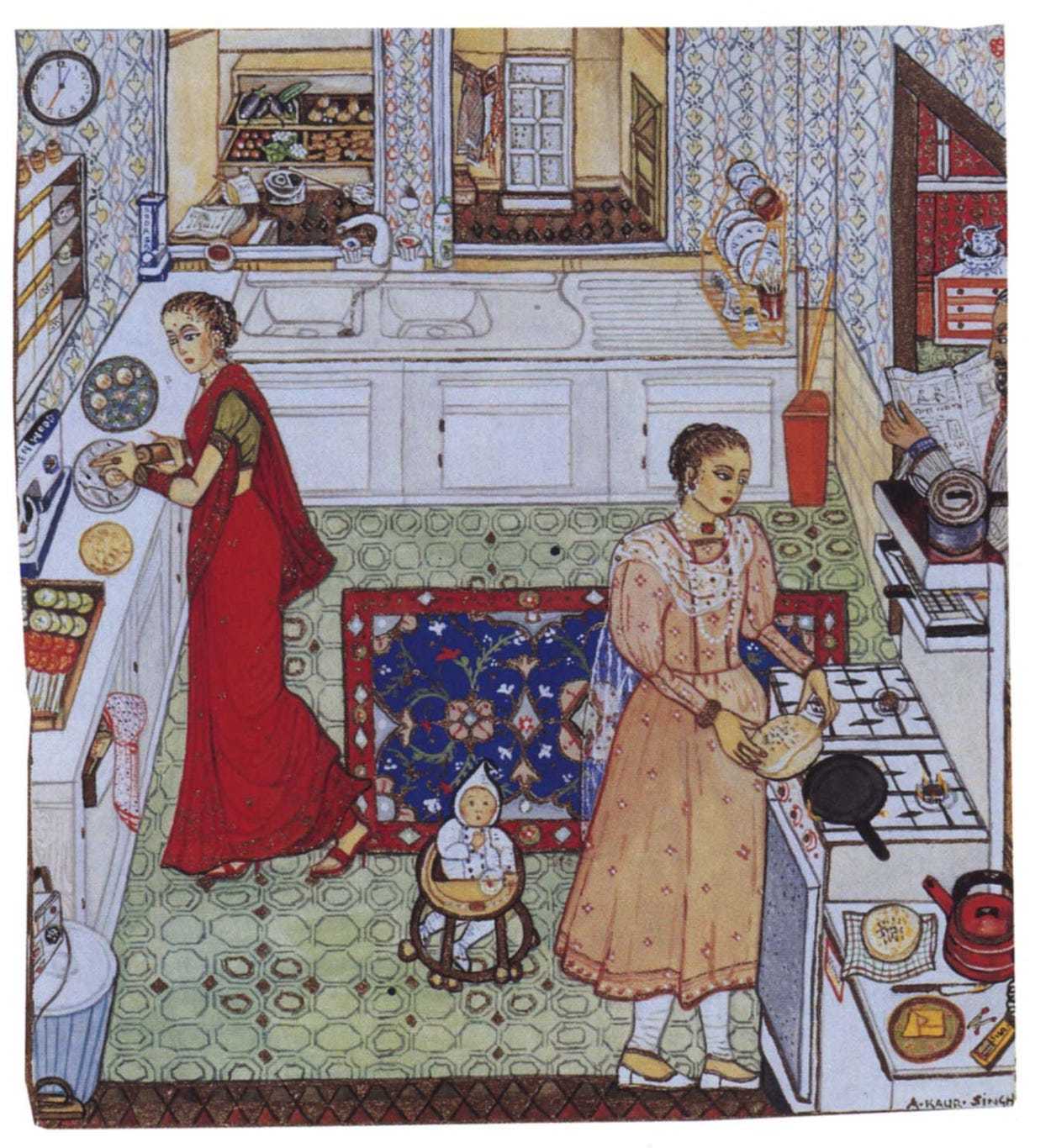
In college, I met women who disliked cooking. Not just rotis, all of it. This was new knowledge to me. Women could and had chosen to not learn cooking, to denounce it. This is not something they just said in vogue, I watched them being grossly incompetent in the kitchen. A characterization that they were willing to live with and did not think that it was an insult to their womanhood. I was worried about how they survived life without knowing a few basics. There were many ways- canteen, restaurants, tapris, other girls who cooked. I was the other girl who cooked.
All the feminist theories questioning the gendered nature of work, gendered roles, and gender itself were put under a microscopic lens and I had to recalibrate my notions about the need to cook in light of contradictory narratives. For a while, I rebelled, I refused to cook anything or even help my mother in the kitchen. I questioned why my brother was not asked or expected to help out. Ma simply said, ‘Karna hai toh karo, warna rehne do’ (Do it if you want or let it be). She did not expect my help in the kitchen because over the years she had learned that I cooked well and enough for myself. She did not need to give me lessons anymore or taunt me about not making rotis. Sweety didi did not do well in college and academia overall, so she was not the gender compass to be followed anymore. My neighbour’s daughter who had a job and got married, was the new ideal daughter. Roti making was now replaced by husband finding while being financially independent. I continued my resistance to this new ‘Sweety’ of my life.
III.
I learned two things in the process, I love to cook for myself, and that feminist theory is great but the practice is always individual as are our battlegrounds. One woman’s struggle cannot be fought with the same arsenal of feminist theories as another’s. I had not only consumed multiple viewpoints on cooking, but they were also contradictory and difficult to navigate. Therein lies the power of ‘not a single story’, as reminded by Chimamanda Ngozi Adichie.
I continue to never cook for my parents while cooking a whole spread for myself, my friends, my partner, and his family. I stopped investigating if I am cooking because of my gender or because it is my love language for myself. I have chosen to embrace and labour to learn Thai cuisine, its ingredients, umami flavours of soy and fish sauce, the richness of sun-dried fish and mushrooms in soups, and the wide range of raw green leaves that are part of the cooking repertoire over ordering or eating out. The fish sauce and green and red curry paste sit next to my garam masala, chole, and sambar powder. Am I not fortunate to have a chance to peel, layer by layer, a new cultural code?
IV.
‘Do you remember the big lunch we hosted?’ I texted my friend one afternoon. ‘Our lives changed even before we sat down’. My friend and I lived in a beautiful Portuguese-style house in Goa. We rented it for a year before I moved to Bangkok. The house was flanked by broad trees as tall as the three-storeyed house and its branches as wide as the eyes could see. There was a pool in front of our house that captured a portion of the blue sky, dancing on its glimmering surface. Our friends were visiting Goa and we invited them over to a ‘Welcome to Goa’ lunch with mango fish curry, prawn masala, poe, jeera aloo, and kala chana. A mix of delicacies from Goa and some from our personal cooking repertoire. ‘I told you, I had a strong feeling that things are about to change,’ she replied from London.
The lunch was ready and the table was set. We were taking turns getting ready for the afternoon. I took a shower and came out of the washroom, my hair wrapped in a thin towel. As I was getting dressed, I picked up my phone to check the new email. I read it and my legs were shaking, like a tremor. Half-dressed, I came out of the room, my eyes fixed on my friend, tuning out everyone else and everything they were saying. I said to her. ‘I got it’. Almost simultaneously, she turned to ask me, ‘Why are you still not dressed?’ and after a pause, added, ‘You got what?’ and added again at a higher pitch this time, ‘YOU GOT IT’. I was still standing there and she came over to me. She hugged me tightly and said congratulations. Our friends were already there and wore puzzled faces, waiting for an explanation for this unexpected burst. I was still stunned and regaining coherence. My friend explained, ‘She got a job and she is moving to Bangkok’. After many rounds of hugs and congratulatory words, we sat down for one of our last meals in the house that changed our lives. The same night after dinner my friend got into LSE to pursue a Master's degree. It all felt serendipitous.
After moving to Bangkok, there are fewer lavish dinners with people but there are many in which I am the sole participant. I cook because it brings a sense of home to me, it makes me care for myself, and it creates a space for me to ask myself how I am feeling. I do not take myself for granted. Even though cooking has acquired the status of a wasteful domestic chore, it remains a peaceful nook in space and time for me. When living alone, the silence within and outside can be cacophonous. In cooking, I found a way of quieting it down with the mandatory requirement of a sequence of steps. Washing, peeling, chopping and so on. The mundane and ordinariness of chopping, peeling, and cleaning soothes my mind and lets me blank out. I sometimes put on some of my music or audiobooks and finish many chapters while muscle memory takes over. I cook ‘Welcome to Bangkok’ dinners and lunches when people visit me. If I cook for you, I am saying I am there for you, just like I am there for myself
Lovely, what a lovely description of the many layers that cooking has exposed you to, I found the gender layer fascinating! Keep writing!! Please cook a “welcome to Bangkok dinner” if I come to Thailand!
Beautiful writing Srishty ! Wonderful to read the love - hate relationship with cooking ( many of us can related to that ) , not being able to cook for some people in our lives , the subtle but cannot be missed comparisons and gender bias and ofcourse the ‘roti ‘ obsession in Indian cooking . Keep Writing !